
 E-Submission
 Yeungnam University College of Medicine
Indexed in: ESCI, Scopus, PubMed,
PubMed Central, Embase, CAS, KCI
PubMed Central, Embase, CAS, KCI
FREE article processing charge

Search
- Page Path
- HOME > Search
Review articles
- Endocrinology, Diabetes, and Metabolism
- Metabolic sarcopenia in the era of incretin-based therapy: a narrative review of mitochondrial determinants of muscle quality and emerging therapeutic strategies
-
Chan Ho Park
 , Jae Han Jeon, Min-Ji Kim
- J Yeungnam Med Sci. 2026;43:61. Published online September 2, 2026
- DOI: https://doi.org/10.12701/jyms.2026.43.61

- 839 View
- 73 Download
-
 Abstract
 PDF
- Glucagon-like peptide-1 (GLP-1) receptor agonists and related incretin-based therapies have transformed obesity and type 2 diabetes mellitus care by producing clinically meaningful weight reductions, improving glycemic control, and modifying cardiometabolic risks. Their success has also exposed a new clinical question: Should weight loss be evaluated not only by magnitude but also by quality? In older adults and patients with obesity, diabetes, physical inactivity, chronic inflammation, or low nutritional reserve, lean mass loss during pharmacological weight reduction may contribute to or exacerbate vulnerability to metabolic sarcopenia, frailty, dysmobility, and fracture risk. Skeletal muscle is a major determinant of glucose disposal and whole-body metabolic flexibility, and mitochondrial dysfunction is increasingly recognized as a convergent mechanism linking insulin resistance, obesity, aging, and sarcopenia. Altered mitochondrial biogenesis, dynamics, mitophagy, oxidative phosphorylation, redox balance, calcium handling, and substrate selection may reinforce metabolic inflexibility and impaired muscle adaptation. Pyruvate oxidation via the pyruvate dehydrogenase complex and its regulatory kinases represents an illustrative pathway within this broader mitochondrial network. This review integrates GLP-1–based metabolic disease management, muscle health, and mitochondrial quality control. We propose a therapeutic framework that combines incretin pharmacotherapy with resistance exercise, protein and micronutrient support, monitoring of body composition and function, and investigational mitochondria-targeted strategies.
- Molecular Biology
- Comprehensive overview of the role of mitochondrial dysfunction in the pathogenesis of acute kidney ischemia-reperfusion injury: a narrative review
-
Min-Ji Kim, Chang Joo Oh, Chang-Won Hong, Jae-Han Jeon
- J Yeungnam Med Sci. 2024;41(2):61-73. Published online February 14, 2024
- DOI: https://doi.org/10.12701/jyms.2023.01347
- 16,951 View
- 227 Download
- 8 Web of Science
- 11 Crossref
-
Abstract
PDF
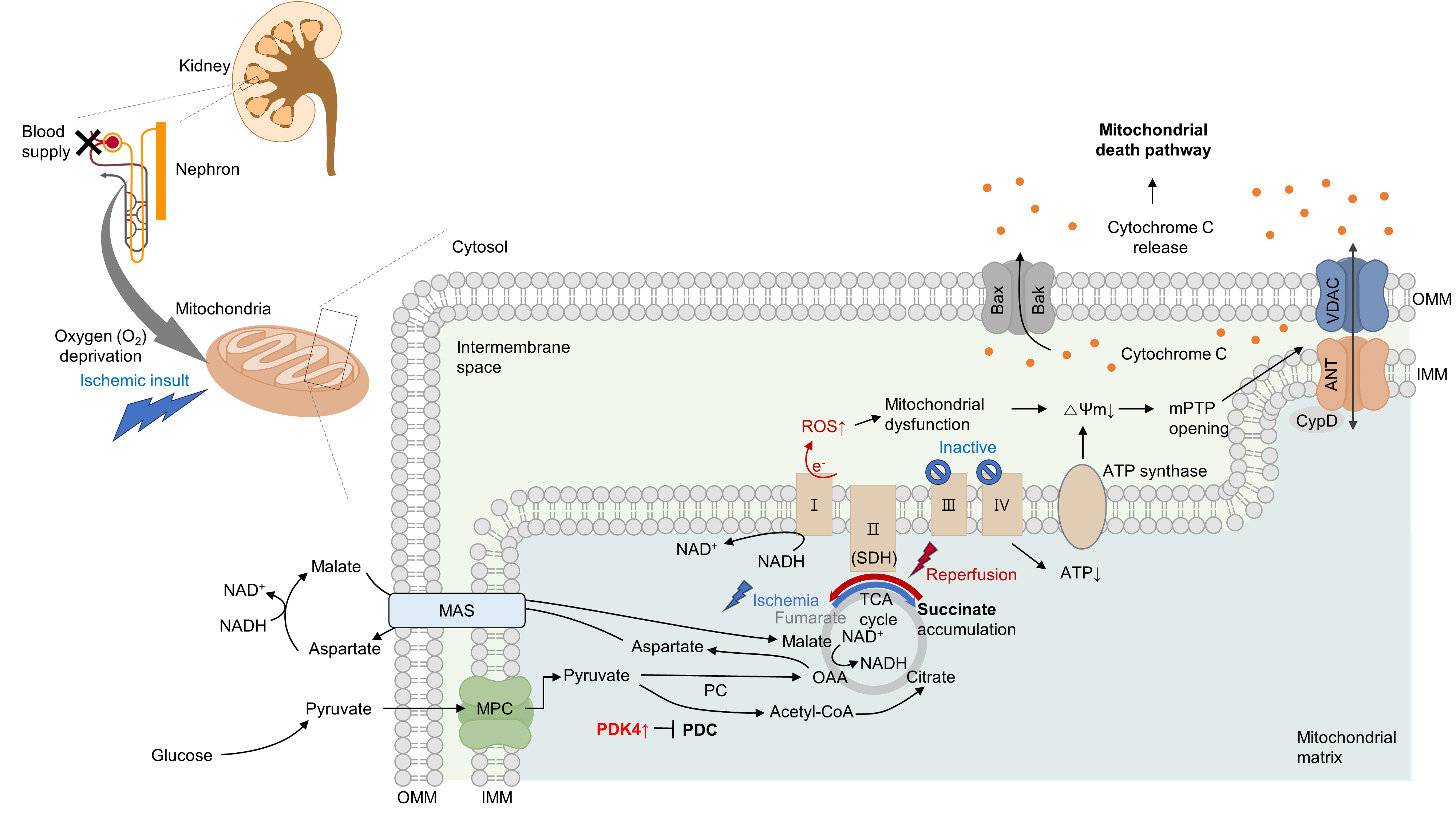
- Acute kidney ischemia-reperfusion (IR) injury is a life-threatening condition that predisposes individuals to chronic kidney disease. Since the kidney is one of the most energy-demanding organs in the human body and mitochondria are the powerhouse of cells, mitochondrial dysfunction plays a central role in the pathogenesis of IR-induced acute kidney injury. Mitochondrial dysfunction causes a reduction in adenosine triphosphate production, loss of mitochondrial dynamics (represented by persistent fragmentation), and impaired mitophagy. Furthermore, the pathological accumulation of succinate resulting from fumarate reduction under oxygen deprivation (ischemia) in the reverse flux of the Krebs cycle can eventually lead to a burst of reactive oxygen species driven by reverse electron transfer during the reperfusion phase. Accumulating evidence indicates that improving mitochondrial function, biogenesis, and dynamics, and normalizing metabolic reprogramming within the mitochondria have the potential to preserve kidney function during IR injury and prevent progression to chronic kidney disease. In this review, we summarize recent advances in understanding the detrimental role of metabolic reprogramming and mitochondrial dysfunction in IR injury and explore potential therapeutic strategies for treating kidney IR injury.
-
Citations
Citations to this article as recorded by
- Targeted delivery of protective substances using nano-sized carriers in ischemic-reperfusion kidney injury
Yu. V. Cheburkin, E. A. Smirnov, E. A. Murashko, A. A. Kolobov, A. B. Bondarenko, N. O. Sitkov, M. M. Galagudza
Nephrology (Saint-Petersburg).2026; 30(1): 20. CrossRef - Pathophysiology-guided biomarkers and therapeutics for precision trauma medicine in polytrauma with musculoskeletal injuries
Rex Jeya Rajkumar Samdavid Thanapaul, Manoj Y. Govindarajulu, Chetan Y. Pundkar, Peethambaran Arun
Military Medical Research.2026; 13(1): 100014. CrossRef - Assessment of redox-related mitochondrial variations in a renal ischemia reperfusion model utilizing a multimodal approach
Gulsum Karduz, Merve Nur Geçin, Muzaffer Utku Cakir, Serap Aktaş Yıldırım, Karolin Yanar, Faruk Kavak, Adem Soylamış, Fevzi Toraman, Ugur Aksu
Archives of Biochemistry and Biophysics.2026; 781: 110824. CrossRef - Redox control at the ER-mitochondria interface in kidney transplantation: MAM-centered stress signaling and translational organoid platforms
Baicheng Kuang, Lin Han, Sopheaktra Tan, Sokun Tan, Sopheap Bou, Yuanyuan Zhao, Yan Li, Jiasheng Yu, Nianqiao Gong
Redox Biology.2026; 94: 104236. CrossRef - Oxidative Stress in Heat Stress Nephropathy: Crosstalk
Justice Afrifa, Eric Gyamerah Ofori, Evans Duah, Ibrahim W. Naveh-fio, Gabriel Pezahso Kotam, Yeboah Kwaku Opoku, Addae Boateng Adu-Gyamfi, Helena Acquah, Enoch Essiam, Samuel Essien-Baidoo, Kwame Kumi Asare, Richard K. D. Ephraim, Priya Gusain
Oxidative Medicine and Cellular Longevity.2026;[Epub] CrossRef - Mitochondrial function in intestinal ischemia-reperfusion injury: mechanisms and therapeutic perspectives
Xuena Han, Zekun Lang, Xinghua Lv, Yang Xing, Min Hou, Zhiguo Tan, Yan Zhang, Yufang Leng
Molecular Biology Reports.2025;[Epub] CrossRef - Hyperoside mitigates amphotericin B-induced nephrotoxicity in HK-2 cells via bioenergetic and oxidative stress modulation
Ekramy M. Elmorsy, Huda A. Al Doghaither, Ayat B. Al-Ghafari, Badriah Abdullah Hifni, Najlaa M.M. Jawad, Noor A. Hakim, Manal S. Fawzy, Nagwa M. Aly
BMC Pharmacology and Toxicology.2025;[Epub] CrossRef - The lactic dehydrogenase-to-albumin ratio predicts acute kidney injury in patients with intracerebral hemorrhage: a multicenter cohort study
Taotao Dong, Yangchun Xiao, Xiang Yuan, Peng Wang, Chao You, Fang Fang, Yu Zhang
Frontiers in Neurology.2025;[Epub] CrossRef - ZNRF2 integrates ubiquitination-driven ferroptosis and mitochondrial quality control in renal ischemia–reperfusion injury
Kangyu Wang, Yun Deng, Changhong Xu, Rui Yan, Hao Wang, Yalong Zhang, Jiangwei Man, Li Yang
Biomedicine & Pharmacotherapy.2025; 192: 118584. CrossRef - The role of gut microbiota–mitochondrial crosstalk in kidney disease: a bibliometric analysis
Qin Hu, Hua Jin, Lan Hu, Xu Li
International Urology and Nephrology.2025; 58(7): 2677. CrossRef - Arfgef3 knockout ameliorates ischemia reperfusion-induced acute kidney injury via mitochondrial dysfunction alleviation in mice
Longyu Wang, Lu Yao, Danshu Xie, Wei Ding
Renal Failure.2025;[Epub] CrossRef
- Targeted delivery of protective substances using nano-sized carriers in ischemic-reperfusion kidney injury
Review Article
- Endocrinology, Diabetes, and Metabolism
- The relationship between muscle mitochondrial nutritional overloading and insulin resistance
-
Jae Han Jeon, Jun Sung Moon, Kyu Chang Won, In Kyu Lee
- Yeungnam Univ J Med. 2017;34(1):19-28. Published online June 30, 2017
- DOI: https://doi.org/10.12701/yujm.2017.34.1.19

- 4,056 View
- 26 Download
-
Abstract
PDF
- The incidence of type 2 diabetes mellitus and insulin resistance is growing rapidly. Multiple organs including the liver, skeletal muscle and adipose tissue control insulin sensitivity coordinately, but the mechanism of skeletal muscle insulin resistance has not yet been fully elucidated. However, there is a growing body of evidence that lipotoxicity induced by mitochondrial dysfunction in skeletal muscle is an important mediator of insulin resistance. However, some recent findings suggest that skeletal mitochondrial dysfunction generated by genetic manipulation is not always correlated with insulin resistance in animal models. A high fat diet can provoke insulin resistance despite a coordinate increase in skeletal muscle mitochondria, which implies that mitochondrial dysfunction is not mandatory in insulin resistance. Furthermore, incomplete fatty acid oxidation by excessive nutrition supply compared to mitochondrial demand can induce insulin resistance without preceding impairment of mitochondrial function. Taken together we suggested that skeletal muscle mitochondrial overloading, not mitochondrial dysfunction, plays a pivotal role in insulin resistance.
 First
 Prev




