
 E-Submission
 Yeungnam University College of Medicine
Indexed in: ESCI, Scopus, PubMed,
PubMed Central, Embase, CAS, KCI
PubMed Central, Embase, CAS, KCI
FREE article processing charge

Search
- Page Path
- HOME > Search
Original articles
- Emergency and Critical Care Medicine
- Hemocompatibility of Emergency Bypass System versus Permanent Life Support extracorporeal membrane oxygenation in a propensity score-matched cohort: analysis of hematologic trajectories and transfusion requirements
-
Woo Sung Jang
 , Jung Uk Woo, Kyungsub Song
- J Yeungnam Med Sci. 2026;43:31. Published online May 7, 2026
- DOI: https://doi.org/10.12701/jyms.2026.43.31

- 1,770 View
- 60 Download
-
 Abstract
 PDF
 Supplementary Material
- Background
The Emergency Bypass System (EBS, Terumo Corporation) and Permanent Life Support (PLS, MAQUET Cardiopulmonary GmbH) platforms differ in pump design and surface coating, which may influence hemocompatibility. This study compared the longitudinal hematological profiles and transfusion requirements of these systems.
Methods
Adult patients who underwent extracorporeal membrane oxygenation were analyzed using 1:1 propensity score matching (74 matched pairs). The primary endpoints included hemoglobin and platelet trajectories during the first 5 days, which were analyzed using linear mixed-effects models.
Results
In the matched cohort, both groups demonstrated statistically similar longitudinal declines in hemoglobin and platelet counts (p=0.525 and p=0.501, respectively). However, this apparent stability in the EBS group was achieved at a significantly higher hematological cost. Within 5 days, the EBS group required 25.5% more red blood cell transfusions (p<0.001) and 34.2% more platelet transfusions (p<0.001) than the PLS group. Multivariable analysis confirmed that the use of the PLS system was independently associated with a lower transfusion demand.
Conclusion
Although laboratory trajectories were comparable during the acute phase, patients supported by EBS experienced a substantially higher transfusion burden. These findings suggest a masking effect, in which compensatory transfusions may obscure the accelerated blood cell consumption associated with EBS. Therefore, clinicians should remain vigilant regarding the potential hidden hematologic costs of EBS support, even when laboratory parameters appear stable.
- Thoracic and Cardiovascular Surgery
- Surgical results of only antegrade del Nido cardioplegia infusion in conventional coronary artery bypass grafting: a retrospective study
-
Sang-Uk Park, Yo Han Bae, Yun Seok Kim, Kyungsub Song, Woo Sung Jang
- J Yeungnam Med Sci. 2023;40(Suppl):S23-S28. Published online June 28, 2023
- DOI: https://doi.org/10.12701/jyms.2023.00283
- 6,262 View
- 67 Download
- 1 Web of Science
- 2 Crossref
-
Abstract
PDF
- Background
Additional retrograde cardioplegia infusion in conventional coronary artery bypass grafting (CABG) was introduced to address the concern of inappropriate cardioplegia delivery through the stenotic coronary artery. However, this method is complex and requires repeated infusions. Therefore, we investigated the surgical outcomes of only antegrade cardioplegia infusion in conventional CABG.
Methods
We included 224 patients who underwent isolated CABG between 2017 and 2019. The patients were divided into two groups according to the cardioplegia infusion method: antegrade cardioplegia infusion with del Nido solution (n=111, group I) and antegrade+retrograde cardioplegia infusion with blood cardioplegia solution (n=113, group II).
Results
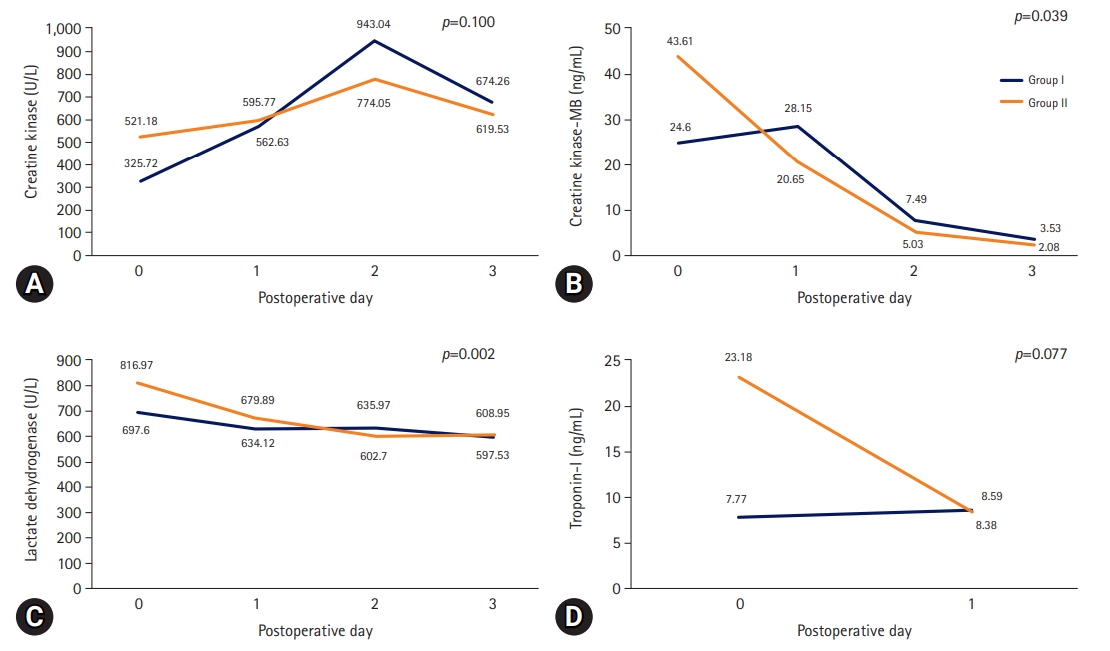
The sinus recovery time after release of the aorta cross-clamp was shorter in group I (3.8±7.1 minutes, n=98) than in group II (5.8±4.1 minutes, n=73) (p=0.033). The total cardioplegia infusion volume was lower in group I (1,998.6±668.6 mL) than in group II (7,321.0±2,865.3 mL) (p<0.001). Creatine kinase-MB levels were significantly lower in group I than in group II (p=0.039). Newly developed regional wall motion abnormalities on follow-up echocardiography were detected in two patients (1.8%) in group I and five patients (4.4%) in group II (p=0.233). There was no significant difference in ejection fraction improvement between the two groups (3.3%±9.3% in group I and 3.3%±8.7% in group II, p=0.990).
Conclusion
The only antegrade cardioplegia infusion strategy in conventional CABG is safe and has no harmful effects. -
Citations
Citations to this article as recorded by
- Del Nido versus conventional blood cardioplegia in patients with combined aortic root surgery: A retrospective study
Yingshan Huang, Xiangni Zhu, Jichang Kong, Ling Zhang, Wenting Gui, Jiao Wang, Yunling Yang, Yan Xie, Dongmei Wang, Xinyue Li, Long Zhou, Yi Song, Xiaoqi Wang
Perfusion.2025; 40(5): 1258. CrossRef - Effect of del Nido Cardioplegia on Isolated Coronary Artery Bypass Grafting: A Study-level Meta-analysis
Yoshiyuki Yamashita, Massimo Baudo, Dimitrios E. Magouliotis, Serge Sicouri, Marry Ann C. Wertan, Danielle D. Spragan, Gianluca Torregrossa, Basel Ramlawi, Francis P. Sutter
Journal of Cardiothoracic and Vascular Anesthesia.2025; 39(6): 1538. CrossRef
- Del Nido versus conventional blood cardioplegia in patients with combined aortic root surgery: A retrospective study
Original Article
- Thoracic and Cardiovascular Surgery
- Investigation of right ventricle function in patients with tetralogy of Fallot after total correction using cardiac magnetic resonance imaging
-
Woo Sung Jang, Hee Joung Choi, Jong Min Lee, Jae Bum Kim, Jae Hyun Kim, Jae Seok Jang
- Yeungnam Univ J Med. 2017;34(2):238-241. Published online December 31, 2017
- DOI: https://doi.org/10.12701/yujm.2017.34.2.238

- 3,923 View
- 9 Download
-
Abstract
PDF
- BACKGROUND
We investigated the difference in right ventricle (RV) volume and ejection fraction (EF) according to the pulmonary valve (PV) annular extension technique during Tetralogy of Fallot (TOF) total correction. METHODS: We divided patients who underwent the procedure from 1993 to 2003 into two groups according to PV extension technique (group I: PV annular extension, group II: no PV annular extension) during TOF total correction. We then analyzed the three segmental (RV inlet, trabecular and outlet) and whole RV volume and EF by cardiac magnetic resonance imaging (MRI). RESULTS: Fourteen patients were included in this study (group I: 10 patients, group II: four patients; male: nine patients, female: five patients). Cardiac MRI was conducted after a 16.1 years TOF total correction follow-up period. There was no statistical difference in RV segmental volume index or EF between groups (all p>0.05). Moreover, the total RV volume index and EF did not differ significantly between groups (all p>0.05). CONCLUSION: The RV volume and EF of the PV annular extension group did not differ from that of the PV annular extension group. Thus, PV annular preservation technique did not show the surgical advantage compared to PV annular extension technique in this study.
 First
 Prev




